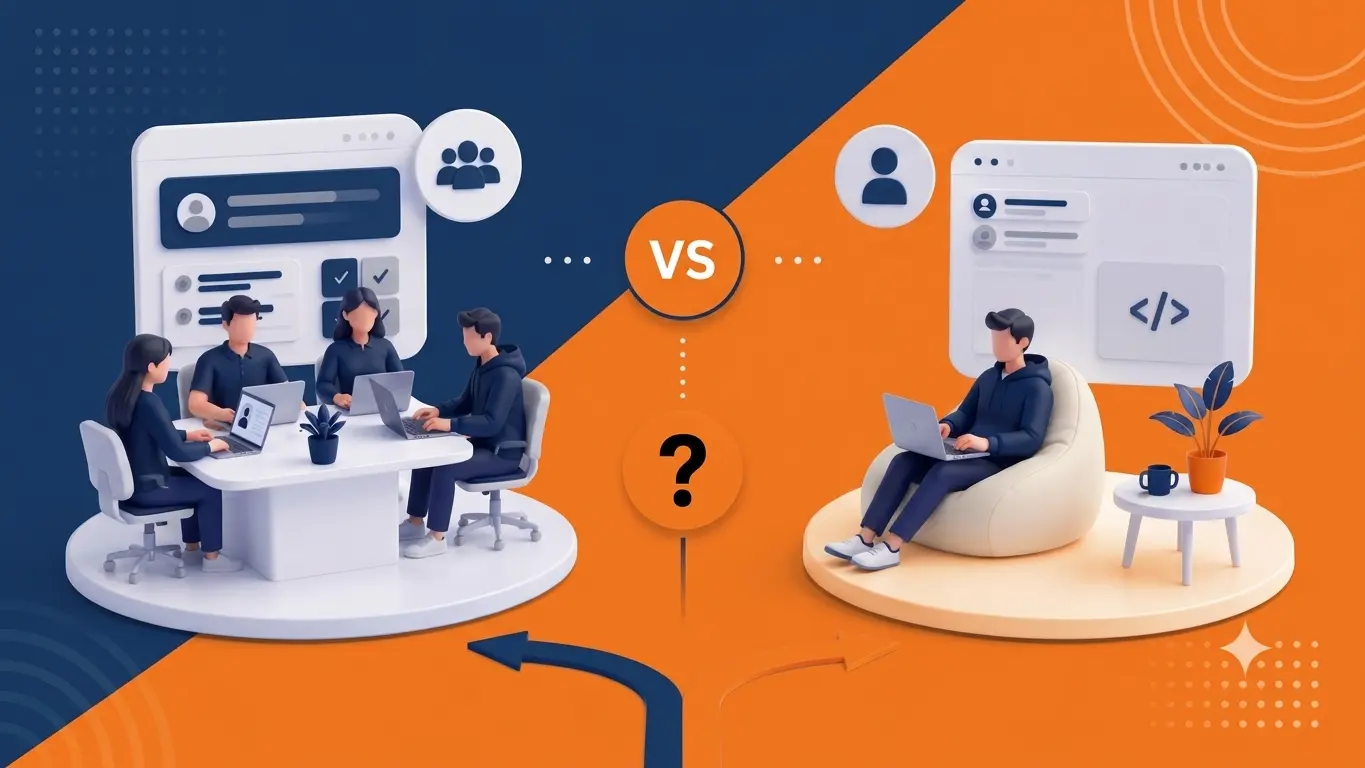
Freelancer vs Dedicated Team: Which Is Better for Long-Term Business Growth?
Quick answer: For long-term business growth, a dedicated team is generally the better choice over a freelancer, because it offers stronger accountability, guaranteed availability, service-level agreements and structure built to scale alongside your business while freelancers work best for short-term, single-task projects where flexibility matters more than continuity.
That's the short version. But the real answer depends on where your business is today, how fast you're growing and how much risk you can absorb if a key resource disappears mid-project. Below, we break down exactly why the freelancer-vs-dedicated-team decision matters more than most businesses realize and how to know which model actually fits your growth stage.
Why This Decision Matters More Than It Seems
Most businesses don't sit down and deliberately choose between a freelancer and a dedicated team. It happens organically when a founder posts a job on a freelance marketplace to get a website built, it works out fine and a pattern forms. Every time something new comes up, the instinct is to hire another freelancer.
That pattern works fine at a small scale. But as a business grows more products, more clients, more complexity, more at stake if something breaks the freelancer model starts showing cracks that weren't visible before. A missed handoff. A freelancer who goes quiet for two weeks during a critical release. A project that has to be re-explained from scratch to someone new because the last person left with all the context in their head.
None of this means freelancers are bad. It means the freelancer model and the dedicated team model are built for different jobs and choosing the wrong one for your growth stage creates risk that compounds quietly until it becomes an expensive problem.
Freelancer vs Dedicated Team: The Core Comparison
Here's how the two models stack up across the factors that matter most for growing businesses:
| Factor | Freelancer | Dedicated Team |
| Accountability | Individual, often informal | Structured, backed by account management |
| Availability | Variable, juggling multiple clients | Full-time, exclusive to your business |
| Business Continuity | High risk if freelancer leaves | Backup resources reduce disruption |
| Scalability | Difficult to scale quickly | Built to expand or contract with demand |
| SLAs | Rare or informal | Formal, contractually guaranteed |
| Onboarding for New Work | Repeated each time | One-time, knowledge retained long-term |
| Communication | Depends on individual's schedule | Structured reporting and check-ins |
| Cost Predictability | Variable, hourly/project-based | Predictable monthly cost |
| Best Suited For | Short-term, single-task projects | Ongoing, evolving, mission-critical work |
This table captures the pattern we see across almost every client conversation: freelancers optimize for short-term flexibility, while dedicated teams optimize for long-term reliability. Neither is universally "better" but for businesses focused on sustained growth, the second column matters far more over time.
Accountability: Who's Actually Responsible for the Outcome?
This is where the freelancer-vs-dedicated-team debate really starts to separate. With a freelancer, accountability is inherently individual and often informal. If a deliverable is late, incomplete, or below expectations, there's rarely a structured escalation path beyond a difficult conversation with that one person.
A dedicated team, by contrast, comes with layered accountability. There's the team member doing the work, but there's also a project or account manager tracking progress, a reporting structure and with a provider like InLinkers CX a company standing behind the delivery, not just an individual freelancer standing behind their own reputation.
For businesses where missed deadlines have real downstream costs: a product launch, a client deliverable, a compliance deadline that structural accountability isn't a nice-to-have. It's the difference between a manageable hiccup and a genuine business problem.
Business Continuity: What Happens When Someone Leaves?
Ask any business owner who's relied heavily on freelancers for more than a year and most will have a version of the same story: a freelancer who was central to a project suddenly became unavailable a new full-time job, a family emergency, simply moving on and took critical, undocumented knowledge with them.
This is the business continuity risk that rarely gets discussed until it happens. Freelancers, understandably, aren't obligated to build in redundancy for your business. They're one person, managing their own schedule and priorities.
Dedicated teams are structured specifically to prevent this. A properly run dedicated team model includes documentation practices, shared knowledge across team members and critically backup resources who can step in if a primary team member is unavailable, whether for a short leave or a permanent departure. Business continuity isn't an accident with a dedicated team; it's designed into the model.
Scalability: Can the Model Grow With You?
Growth rarely moves in a straight line. A business might need one developer this quarter and three next quarter after landing a major client. This is where the scalability gap between freelancers and dedicated teams becomes obvious.
Scaling with freelancers means starting from zero each time: posting new roles, vetting new candidates, negotiating new rates and hoping the new hire integrates well with existing freelancers who may never have worked together before. It's slow and it's unpredictable.
Scaling with a dedicated team, particularly through an established outsourcing partner, is a fundamentally different experience. Because the provider already understands your business, your codebase or workflows and your standards, adding capacity typically means requesting additional team members who are onboarded into an existing structure not starting a hiring process from scratch. This is one of the clearest, most measurable advantages dedicated teams offer growing businesses.
SLAs: The Difference Between a Promise and a Guarantee
A Service Level Agreement (SLA) is a formal, contractual commitment around response times, deliverable quality, availability and resolution timelines. Freelancers rarely offer SLAs in any meaningful sense; most freelance engagements run on informal expectations and good faith.
Dedicated teams, especially those provided through an established BPO or outsourcing company, typically operate under formal SLAs that specify things like:
- Guaranteed weekly or monthly working hours
- Defined response times for issues or requests
- Quality benchmarks and review cycles
- Escalation procedures if standards aren't met
For businesses where reliability is non-negotiable client-facing work, production systems, revenue-generating platforms an SLA converts vague expectations into an enforceable commitment. That's a structural advantage freelancers, by the nature of individual, informal work, simply can't replicate.
Cost: The Real Math Beyond the Hourly Rate
On paper, freelancers often look cheaper. A freelance developer might quote $15–$25/hour, while a dedicated team member through an outsourcing partner might run $1,200–$1,900/month depending on seniority and specialization. The hourly comparison seems to favor freelancers until you factor in the hidden costs that come with the freelance model:
- Re-hiring costs every time a freelancer moves on and a replacement needs to be found and onboarded
- Rework costs when a freelancer with limited context misunderstands scope or quality expectations
- Management overhead the time business owners or managers spend coordinating, chasing updates and re-explaining context
- Opportunity cost of delayed timelines when a freelancer becomes unavailable mid-project
When these are added up, many businesses find the "cheaper" freelancer option costs more over a 12-month period than a dedicated team with predictable monthly pricing, consistent output and no re-hiring cycle. This is precisely the hidden-cost pattern we cover in more depth on our comparison page.
Communication and Time Zone Reliability
Freelancers, particularly those working across multiple clients simultaneously, often communicate on their own schedule which can mean delayed responses, missed meetings, or work that happens out of sync with your business's operating hours.
Dedicated teams, by design, align to your working hours and reporting cadence. Whether it's daily stand-ups, weekly progress reports, or direct Slack/Teams access during your business day, the communication structure is built around your operational needs rather than fitting into whatever gaps exist in a freelancer's schedule. For US and UK businesses working with a dedicated team based in Pakistan, this typically means structured overlap hours are built directly into the engagement, something freelance arrangements rarely formalize.
Security, IP Protection and Compliance
For any business handling sensitive data, customer information, proprietary code, financial records, healthcare data security and IP protection are not optional considerations.
Freelancers, especially those sourced through open marketplaces, often work with minimal formal security infrastructure. NDAs may exist, but enforcement across an international freelancer with no organizational backing can be difficult in practice.
Dedicated teams operating through an established company typically include company-backed NDAs, defined data handling protocols, restricted access controls and depending on the provider compliance alignment with standards like GDPR or HIPAA for regulated industries. This organizational backing, rather than relying on an individual's personal commitment to confidentiality, is a meaningful risk reducer for growing businesses handling sensitive information.
When a Freelancer Is Actually the Right Choice
To be fair to the freelance model, there are real scenarios where hiring a freelancer makes complete sense:
- A single, well-defined task with a clear start and end (a logo design, a one-time landing page)
- Testing a new idea before committing to ongoing resourcing
- Highly specialized, short-term expertise not needed on an ongoing basis
- Very tight, short-term budget constraints with low risk tolerance for the specific task
If your need genuinely fits one of these patterns, a freelancer can be faster and more cost-effective than building out a dedicated team for a job that won't recur.
When a Dedicated Team Is the Right Choice
A dedicated team becomes the stronger choice once a business hits patterns like these:
- Work is ongoing and evolving, not a single defined deliverable
- Business continuity matters a missed deadline or resource gap has real consequences
- You expect to scale the work up (or occasionally down) over time
- You need formal accountability, reporting and SLAs rather than informal arrangements
- Security, compliance, or IP protection are business-critical
- You've already been burned by a freelancer disappearing mid-project
If two or more of these describe your business today, it's a strong signal that the dedicated team model will serve your growth better than continuing to rely on freelancers.
Signs You've Outgrown Freelancers
Many of our clients at InLinkers CX come to us after specifically recognizing these warning signs in their own operations:
- Constantly re-explaining project context to new freelancers
- Missed deadlines becoming a recurring pattern rather than a rare exception
- Growing anxiety around what happens if a key freelancer becomes unavailable
- Spending more time managing freelancers than actually running the business
- Inconsistent quality across different freelance hires for similar work
If several of these sound familiar, it's usually a sign that your business has scaled past the point where the freelance model can reliably support it.
How InLinkers CX Structures Dedicated Teams
At InLinkers CX, our dedicated team model is built specifically to address the gaps that come with freelance hiring:
- Exclusive resources your dedicated team members work only for your business, not juggling multiple clients simultaneously
- Backup coverage built-in redundancy means business continuity isn't dependent on a single individual
- Formal SLAs defined availability, response times and quality benchmarks from day one
- Structured onboarding a repeatable process (browse & shortlist, NDA & proposal, interview, go-live) that gets teams operational quickly without sacrificing vetting quality
- Account management a dedicated point of contact overseeing delivery, not just the individual contributors doing the work
- Scalable structure capacity can expand or adjust as your business needs change, without restarting the hiring process each time
This structure is what allows businesses to move from the unpredictability of freelance hiring to a model built for sustained, long-term growth.
How to Make the Switch Without Disrupting Your Business
For businesses currently relying on freelancers and considering a shift to a dedicated team, a phased transition tends to work better than an abrupt switch:
- Audit your current freelance dependencies identify which roles are recurring versus genuinely one-off
- Prioritize the highest-risk roles first start with functions where continuity matters most (core development, ongoing support)
- Run the dedicated team in parallel initially overlap with existing freelancers during onboarding to preserve context and avoid gaps
- Document institutional knowledge capture what freelancers know before fully transitioning away from them
- Scale gradually add dedicated team capacity as confidence and trust build, rather than converting everything at once
This approach lets businesses de-risk the transition while still capturing the long-term benefits of a more stable, accountable hiring model.
Considering whether a dedicated team fits your growth plans? Talk to InLinkers CX about building a team structured around your business not the other way around.
Frequently Asked Questions
Does InLinkers CX offer both freelance-style and dedicated team engagements?
InLinkers CX specializes in dedicated team models exclusive, full-time resources backed by SLAs, account management and backup coverage rather than the informal, per-task structure of freelance marketplaces. This focus is exactly why our clients choose us for ongoing, long-term work rather than one-off tasks.
How quickly can InLinkers CX get a dedicated team up and running?
InLinkers CX follows a structured onboarding process shortlisting, NDA and proposal, interviews and go-live that typically gets a dedicated team operational within about two weeks, without sacrificing the vetting quality needed for long-term reliability.
What happens if a dedicated team member from InLinkers CX becomes unavailable? Because InLinkers CX builds backup coverage into every dedicated team engagement, business continuity isn't dependent on a single individual. If a team member is unavailable, a qualified backup resource with shared project knowledge can step in, minimizing disruption to your timeline.
Can InLinkers CX scale a dedicated team up or down as our business needs change? Yes. InLinkers CX structures dedicated teams to expand or adjust based on your evolving requirements, so scaling capacity doesn't mean restarting a hiring process each time new team members are onboarded into an existing, already-understood structure.
Does InLinkers CX provide SLAs and formal accountability for dedicated teams? Every dedicated team engagement through InLinkers CX includes defined SLAs covering availability, response times and quality benchmarks, backed by dedicated account management giving businesses a level of formal accountability that informal freelance arrangements typically can't offer.
About InLinkers
InLinkers CX A Leading BPO & Call Center Company Delivering Scalable Solutions Worldwide
Recent Posts

Why Outsource to Pakistan? A Complete Gu...

Top Business Process Outsourcing Service...

Dedicated Team vs In-House Hiring: Which...
Freelancer vs Dedicated Team: Which Is B...
How to Choose the Best Outsourcing Partn...
Contact us
Get instant solutions for your business, drop us a message for instant help
Send